In this article, you'll discover:
- Why people who feel deeply often feel drained after being around others
- The difference between emotional perception and emotional absorption
- How hypervigilance develops through the nervous system
- Why time alone doesn’t always restore your energy
- How to reconnect with what genuinely belongs to you
Many individuals leave conversations feeling emotionally heavy, mentally exhausted or strangely overwhelmed — even when nothing openly difficult was said.
After hundreds of sessions, I've noticed that many people who describe themselves as emotionally overwhelmed are not overwhelmed by their own emotions alone. They are often carrying tension, expectations, fears or emotional burdens that were never theirs to carry in the first place.
Sometimes, you spend time with someone and immediately feel that something is “off” without being able to explain why.
Other times, you leave an interaction replaying the part of conversation in your mind, slowly realising that your body had already sensed discomfort, tension or crossed boundaries long before your conscious mind fully recognised it.
For deep feelers, emotional perception does not happen only through words.
The body itself is constantly listening:
- tone of voice,
- facial expressions,
- emotional atmosphere,
- tension,
- subtle changes in energy or behaviour.
And over time, this level of emotional attunement can become exhausting.
Especially when you no longer fully know what genuinely belongs to you — and what you may be unconsciously absorbing from others.
Why You Leave Conversations Feeling Heavy (Even When Nothing Was Said)
You may walk into a room and immediately feel tension before anyone speaks. You leave and the heaviness stays with you — sometimes for hours.
You may notice emotional shifts in your partner before they openly express anything.
You may even feel emotionally activated around people who appear perfectly calm externally.
Sometimes, your body reacts before your mind fully understands why:
- fatigue,
- anxiety,
- a contraction of the chest,
- a sudden need to withdraw.
- a pain appearing from nowhere,
- irritability or a feeling of restlessness,
- a strong urge to leave, withdraw, or be alone, Your body often notices long before your conscious mind catches up.
Many empathic people spend years believing they are:
- too emotional,
- too intense,
- too much
- or simply unable to cope with life normally.
But often, the nervous system has simply become extremely attuned to emotional environments and relational tension.
Some nervous systems are naturally more sensitive to emotional environments.
This does not mean something is wrong with you. But it does mean your system may process emotional information much more deeply than the people around you.
For some people, emotional absorption is not only linked to natural sensitivity.
It can also develop through a nervous system that learned to stay constantly alert in order to feel safe emotionally.
When growing up around conflict, emotional unpredictability or emotionally unavailable caregivers, the body often becomes highly attuned to subtle emotional changes in the environment.
The nervous system learns to monitor tone, tension, moods, silence or emotional shifts automatically.
For many sensitive people, this pattern develops gradually over years. When the body experiences repeated stress, emotional unpredictability or situations that feel overwhelming, the nervous system naturally adapts in order to protect us. For some people, this may involve becoming more vigilant to emotional cues, moods and subtle changes in the environment.
From a Polyvagal perspective, the system may spend more time in sympathetic activation — constantly scanning for potential tension or danger — or move between sympathetic activation and dorsal withdrawal when overwhelm becomes too much.
What begins as a protective response can eventually become automatic. Without realising it, you may become highly attuned to what others are feeling while slowly losing connection with your own emotions, needs and limits.
What is your nervous system carrying?
24 questions.
No right or wrong answers.
Discover which pattern is most active in your life right now.
Takes about 3 minutes
© 2026 Inner Alchemy with Xavier · xavierandignac.fr
Now that you have your profile — you understand something important. The exhaustion you feel after interactions is not a character flaw. It is a nervous system running a pattern it learned for a very good reason.
The good news is that patterns can change. Not through willpower — but through the body.
Not because the person is weak or “too emotional,”
but because the body adapted to survive relationally.
Over time, this hypervigilance can remain active long after the original environment has disappeared.
In my own practice, I pay close attention to signs of nervous system state.
Over the years, I also developed an energetic assessment process that helps me explore where a person may be operating from and what may help them return to greater regulation and connection.
Sometimes I Don’t Even Know What I Truly Feel Anymore
Especially in relationships, emotional absorption can become deeply confusing.
For many people, this does not happen consciously. Over time, the nervous system may learn that staying connected to others is important for safety, belonging or avoiding conflict.
Attention begins moving outward.You become highly aware of what others feel, need or expect — sometimes at the expense of noticing your own emotions, needs and limits.
Over time, you may become so focused on sensing the emotional needs, moods or tension of others that you slowly lose connection with your own internal signals.
Sometimes you know your partner’s emotional state more clearly than your own
Sometimes you know your partner’s emotional state more clearly than your own:
- You adapt,
- You monitor,
- You anticipate.
- You try to keep emotional balance in the relationship.
And little by little, the body can become conditioned to constantly scan for tension or emotional shifts in order to stay emotionally safe or connected.
This often develops so gradually that it simply feels normal. You may not realise how much energy your system spends monitoring emotional environments because you have been doing it for years.
What once began as adaptation can eventually become automatic.
Without fully realising it, You may find yourself constantly scanning the environment for subtle signs:
- Tone of someone's voice,
- Facial expressions,
- Awkward Silence,
- Tension in the room,
- A shift in the emotional atmosphere,
- Anything that feels "off”
The exhausting part is that the interaction often continues long after it has ended.
You replay the conversation in your mind, wonder what you should have said, what you shouldn’t have said, and sometimes realise only hours later that one of your boundaries was crossed.
And afterwards, you may feel:
- Guilty,
- Frustrated,
- Emotionally drained,
- Uncomfortable for not having listened to yourself earlier.
I remember periods in my own life where I would leave certain interactions feeling emotionally exhausted without fully understanding why.
For years, I mistook self-abandonment for kindness.
Even when I felt disconnected, exhausted, or ready to leave, I would force myself to stay so I wouldn’t disappoint others or be judged.
The result was often a strange feeling of being present physically but absent emotionally.
Looking back, these were not signs that something was wrong with me.
They were signs that my body was asking me to listen.
But little by little, I realised my body had been constantly monitoring emotional tension, adapting to other people’s emotional states and ignoring my own limits long before I consciously recognised it.
The body had been monitoring emotional tension long before I consciously recognised it.
Over time, this emotional vigilance can become physically anchored in the nervous system and body itself.
Many people notice it as persistent tension in the neck, trapezius, jaw, chest, or diaphragm, while others experience it more deeply through the belly, hips, and psoas muscles.
→ Read: The Trapezius and Neck: Linked to Hypervigilance and the Body’s Threat-Detection System
During periods where I was travelling alone through France and Belgium by bicycle, I often stayed in very different environments and around many different people from one day to another.
At the time, I noticed how strongly my body and energy reacted to certain places, interactions or atmospheres — even when nothing visibly difficult had happened.
Sometimes I would suddenly feel exhausted or sad for no clear reason.
The following day, while crossing forests or natural spaces, I would consciously ask nature to help cleanse what I had emotionally and energetically absorbed.
The more I was doing it, the more I could physically feel energy moving through my body again, as if something heavy was finally leaving my system.
And when there were no forests around me, I would use other elements instead:
- air,
- water,
- or the warmth of the sun.
Little by little, I realised how deeply people can absorb not only emotions psychologically, but sometimes also energetically through the body itself.
At the time, I didn’t have a framework to explain what I was experiencing.
Years later, during my energy healing training, I discovered that many of the cleansing and grounding practices I was being taught were remarkably similar to what I had been doing intuitively for years.
It helped me understand something important:
People who are highly attuned to others often absorb far more than they realise.
And just as important as opening ourselves to others is learning how to return to ourselves afterwards.
Today, this is also why I pay close attention to grounding, regulation and energetic hygiene before and after working with clients.
Not because something is “wrong” or “dangerous,” but because a sensitive system often benefits from consciously releasing what does not belong to it.
Why Isolation No Longer Fully Restores You
Many people who are constantly aware of others cope by withdrawing:
- Wanting silence,
- Wanting space,
- Wanting to disappear into their own “cave” for a while.
And sometimes this genuinely helps temporarily.
But over time, constantly isolating no longer fully restores what the body has been carrying underneath for years.
It can start feeling like constantly placing a lid over emotional tension that never truly had space to move or be processed.
Placing a lid on difficult emotions doesn't make them disappear.
The body and nervous system may continue carrying what has not been fully processed.
Over time, this can show up in ways that don't immediately seem related:
- Restlessness,
- Overthinking,
- Emotional overwhelm,
- People-pleasing,
- Difficulty setting boundaries,
- Relationship struggles,
- Persistent tension,
- Difficulty slowing down,
- Feeling disconnected from yourself,
When these experiences become part of daily life — or have simply always been there — it's natural to look for an explanation.
You may begin to believe that this is simply who you are.
Perhaps you've told yourself:
- "I'm just an anxious person."
- "I'm an overthinker."
- "I need more rest."
- "I'm too sensitive."
- "I need stronger boundaries."
- "This is just my personality."
- "I've always been like this."
- "Everyone in my family is like this."
- "The women in my family all react this way."
- "That's just how we are."
While these explanations can contain part of the truth, they often focus on the symptom rather than what may be driving it.
What we notice most is often what appears above the surface.
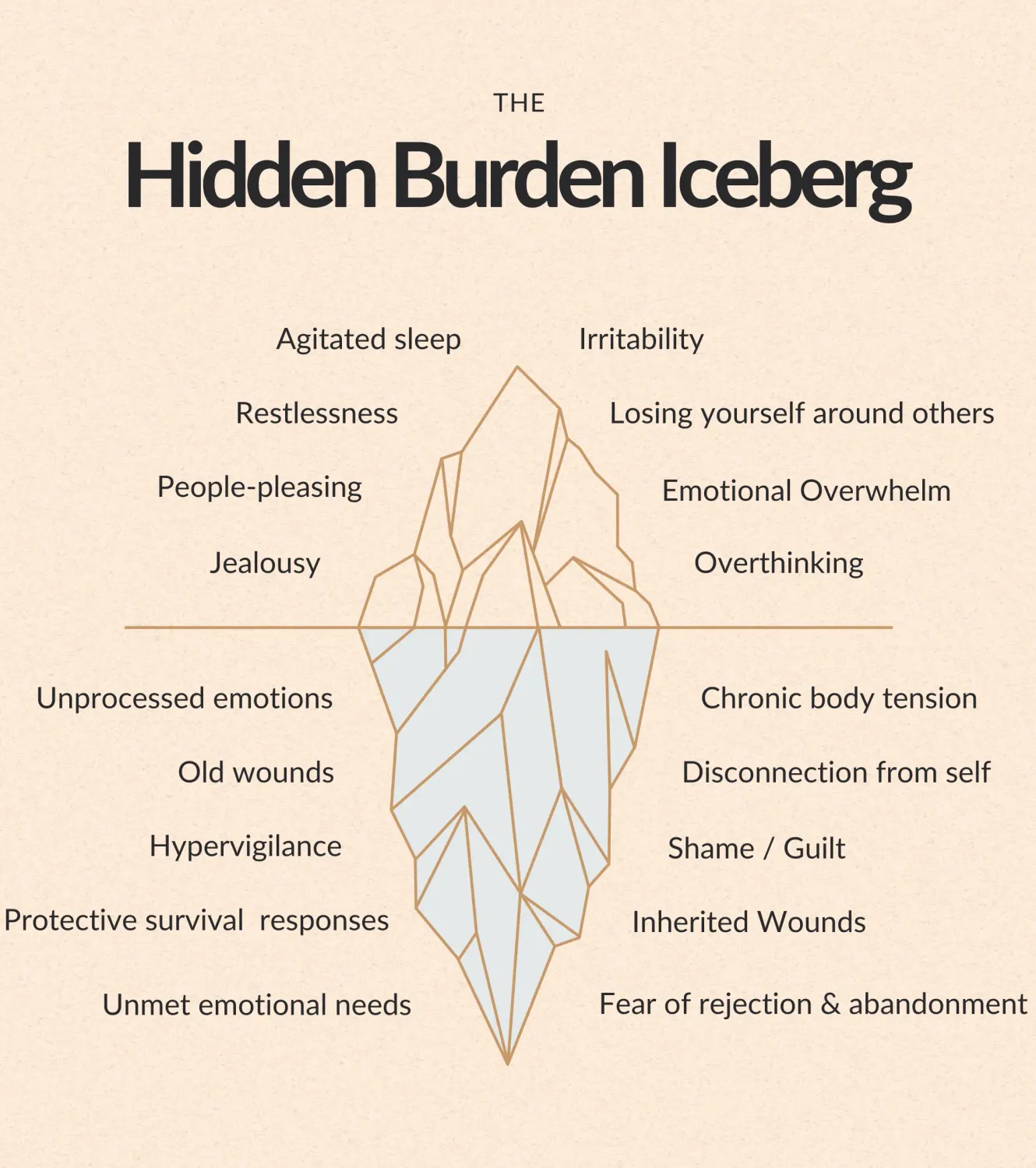
Beneath the symptoms we notice most easily, the body and nervous system may still be carrying emotional wounds, unmet needs, protective patterns, fears, beliefs, or burdens that were never fully processed.
What appears above the surface is often only part of the story.
Sometimes, what we struggle with is not the symptom itself, but what the symptom may be trying to protect, express, or reveal.
The Body Remembers Emotional Environments
Emotional overwhelm is often felt not only emotionally, but physical
The body remembers what the mind has learned to live with.
Over time, this can show up as:
- Jaw tension,
- Chest tightness,
- Digestive issues,
- Shallow breathing,
- Chronic fatigue,
- Emotional reactivity,
- Sleep difficulties,
- Constant feeling of being internally “on alert.”
The body learns to stay prepared.
Prepared for tension.
Prepared for emotional shifts.
Prepared for disappointment, conflict or emotional unpredictability.
And after years of this, hyper-attunement can begin feeling normal.
Many people no longer even realise how much energy their system spends constantly monitoring emotional environments.
Sensitivity Is Not Weakness
One of the biggest shifts for many these people is realising that sensitivity itself is not the problem.
In many cases, sensitivity is actually a refined form of perception.
The real difficulty often comes from:
- Chronic emotional overload,
- Lack of boundaries,
- Emotional suppression,
- Nervous system exhaustion,
- Years of carrying emotions that were never fully processed.
Sensitivity can become exhausting when the body never truly gets to return to safety.
But when understood more consciously, this same sensitivity can also become:
- Deeper emotional intelligence,
- Stronger intuition,
- Relational awareness,
- Empathy,
- Creativity,
- Ability to create deeply safe therapeutic or relational spaces,
- Much deeper connection to oneself and others.
For some people, presence itself becomes healing. Not through fixing or forcing change, but through the ability to truly feel, listen and remain emotionally present with what another person is experiencing.
Over time, I also realised that my sensitivity was not only making me feel more. It was also allowing me to perceive certain emotional dynamics, tensions or underlying patterns that often remained unspoken.
Sometimes, simply being deeply present and authentic around others seemed to bring hidden emotions, discomfort or truths closer to the surface.
At first, this felt confusing. Later, I began understanding that sensitivity can also become a capacity to accompany transformation — not by forcing change, but by helping people safely reconnect with what has remained unseen, unprocessed or emotionally avoided for years.
The goal is not becoming less sensitive.
It is learning how to stay connected to yourself while remaining open to the world around you.
For many sensitive people, healing does not begin by becoming less open or less empathic.
Healing is not about closing yourself off from the world. It is learning how to stay connected to yourself while remaining open to the world around you.
Healing often begins by reconnecting with yourself deeply enough to recognise what genuinely belongs to you.
For some people, this also means developing deeper body awareness and learning to recognise their own internal signals more clearly.
Over time, this can create greater discernment:
- the ability to distinguish between your own feelings,
- your perception of what others may be experiencing,
- the stories or assumptions your mind may create around them.
Sometimes we sense something accurately. At other times, we may unconsciously interpret a facial expression, tone of voice, silence, or change in behaviour through the lens of our own history rather than what is actually happening.
A look, a message left unanswered, or a shift in someone’s energy can quickly take on a meaning that reflects our fears, expectations, or past experiences more than reality itself.
Discernment is not about becoming less sensitive.
It is about becoming curious enough to pause, question your first interpretation, and remain open to what is true. It is learning to feel deeply without immediately assuming you know what another person is experiencing. Sometimes the clearest path to understanding is not interpretation, but genuine curiosity and conversation.
For me, one of the biggest shifts came when I stopped trying to push through what I was feeling.
Instead of forcing myself to stay, perform, or adapt, I gradually learned to notice the signals my body had been sending all along.
The tension.
The frustration.
The sense of disconnection.
What I once ignored became valuable information.
Over time, this created more space to respond to my needs rather than constantly overriding them.
Learning to Distinguish What Is Yours
Healing often begins with a simple but powerful question:
What am I truly feeling right now — and what might I be absorbing from around me?
For many empaths, this takes time. Because emotional absorption often becomes automatic long before we consciously notice it.
This is also why emotional overwhelm cannot always be resolved through positive thinking or boundaries alone.
Sometimes the nervous system itself first needs to relearn what emotional safety, grounding and internal stability actually feel like inside the body.
Little by little, the goal is not to shut down sensitivity.
But to remain connected to yourself without constantly carrying everyone else emotionally inside your own body.
Meet the person behind this article

Hi, I’m Xavier.
Many of the patterns described in this article were once part of my own experience.
For years, I tried to understand myself through thinking, analysing, and searching for answers. Yet despite understanding many things intellectually, I often felt disconnected from myself.
What changed my life was realising that understanding alone wasn’t enough. The body was carrying things the mind had already understood.
This discovery led me to explore coaching, somatic approaches, nervous system work, and energy healing.
Over time, I developed an approach that bridges mind, body, and spirit to help people uncover what lies beneath the surface, release what no longer serves them, and integrate lasting change.
Today, I work with empathic, intuitive, and reflective people who want to better understand themselves, reconnect with their inner guidance, and move toward greater clarity, alignment and fulfilment.
Helping people reconnect with themselves, release what no longer serves them, and discover what wants to emerge.
References
- Acevedo et al. (2018) – Highly Sensitive Person Trait → [PubMed](1. PubMed)
- Coutinho et al. (2014) – Emotional Contagion & Empathy → [PubMed](3. PubMed)
- Porges (2022) – Polyvagal Theory & Nervous System Regulation
- Leikert (2023)– Body Memory & Emotional Storage → [PubMed](5. PubMed)
- Siegel (2020) – Interpersonal Neurobiology & Emotional Attunement
- Van der Kolk (2014) – Trauma and the Body
- Aron & Aron (1997) – Sensory Processing Sensitivity