In this article, you'll discover:
- Why some emotional patterns may not have started with you
- Why understanding yourself doesn't always create change
- How the nervous system stores survival patterns
- Why some struggles remain despite years of inner work
- What highly sensitive people often need in order to heal
You have probably spent years wondering why your life feels heavier for you than it seems to for others.
You feel things deeply.
You notice what others miss.
You sense tension in your body before words are spoken.
And even when you try to rest, your mind and body often struggle to fully switch off.
At some point, this can become exhausting.
Not only because of what you carry personally — but because your system seems to absorb far more than the people around you.
Sometimes, it can feel as if your whole body is sensing in multiple directions at once.
Like an octopus exploring the world through multiple points of contact — constantly reading tension, emotional shifts, atmosphere and subtle changes long before anything is openly expressed.
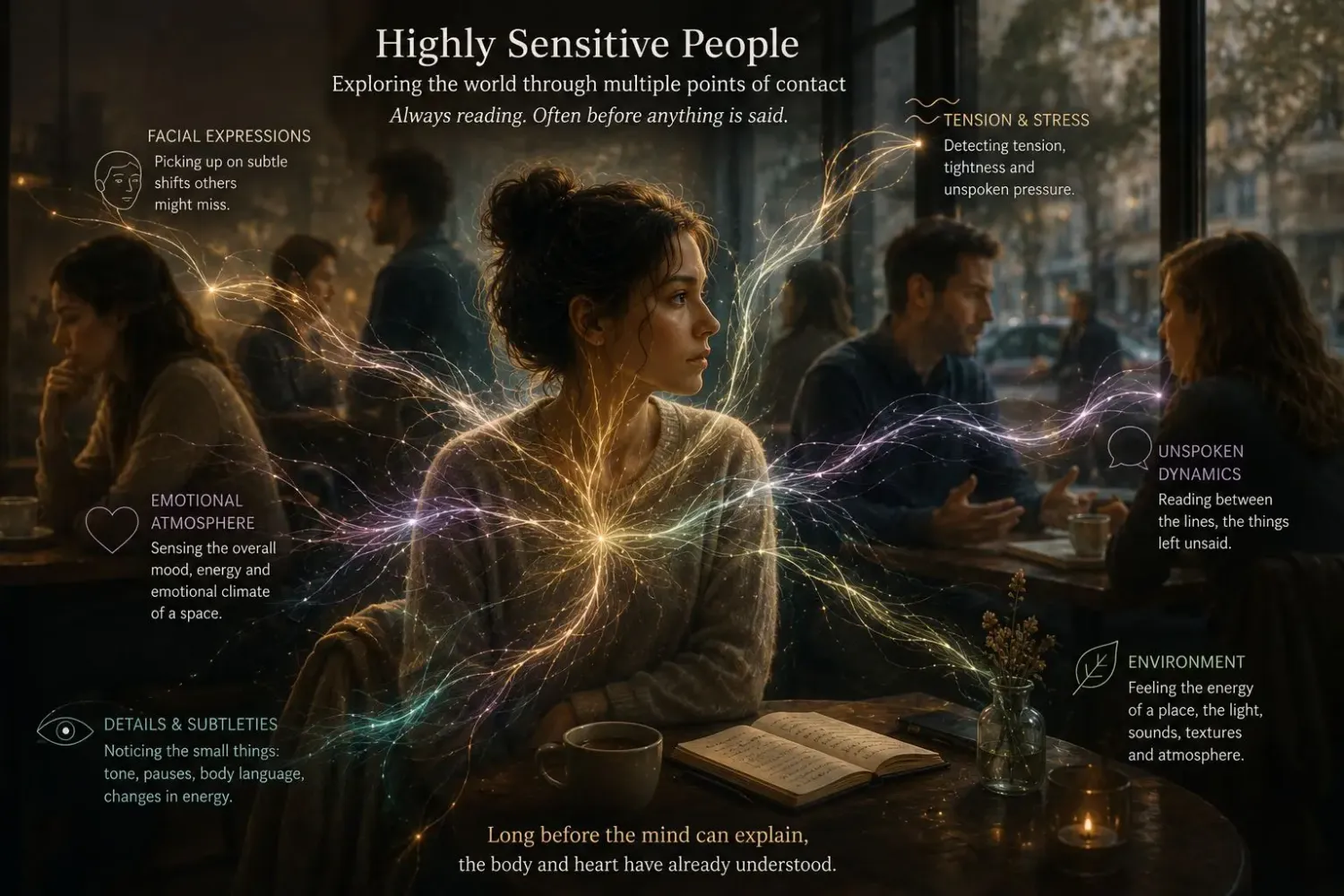
For many people, perception no longer happens only through thought. The body itself is constantly listening.
Many sensitive and intuitive people grow up believing something is wrong with them.
Too emotional.
Too anxious.
Too sensitive.
Too intense.
Too affected by everything.
So they learn to adapt:
- Hiding what they feel,
- Overthinking, replaying conversations
- Pleasing others,
- Disconnecting from the body,
- Not listening to their intuition and regretting it after
- Constantly staying mentally alert,
- Carrying emotional weight they cannot fully explain.
But sensitivity itself is not the problem.
For a long time, I tried to understand this through analysis, logic and self-observation — the way I had learned to understand everything else in my life.
For me, the first real shift happened years ago when I worked with a coach specialised in multipotentialite profiles.
As she described the traits and inner experience of highly sensitive and multipotential people, something inside me broke open.
For the first time in my life, I felt deeply seen. I remember crying — not from sadness, but from the relief of finally understanding that I was not simply “too much,” strange or broken.
She later introduced me to concepts like Highly Sensitive Person (HSP) and empath, and suddenly many parts of my life started making sense.
But over the years, I also realised something important: Healing was not about building a new identity around sensitivity.
It was about understanding how I experienced the world — and learning how to relate to my sensitivity consciously instead of constantly fighting against it.
Little by little, I also began realising that some of the traits I had experienced as burdens for most of my life were not simply weaknesses to fix.
Certain forms of sensitivity were actually forms of perception:
- The ability to feel what remained unspoken beyond words.
- To sense tension, emotional weight or deeper patterns before they became fully visible consciously.
- To recognise what people were carrying underneath the surface — sometimes before they could recognise it themselves.
What once felt overwhelming gradually became something I could work with more consciously and in a grounded way.
Not as a special identity.
But as a deeper way of listening:
- to the body,
- to emotion,
- to human patterns,
- to the parts of people that often remain hidden beneath adaptation and survival.
Many people spend years trying to manage these patterns mentally without realising how deeply they have become embodied.
What begins as adaptation can slowly become identity:
- Staying alert,
- Over-processing,
- Suppressing emotion,
- Disconnecting from the body's signals,
- Carrying emotional tension for so long that it no longer feels noticeable.
The aim of this article is not to place you inside another label.
It is to help you recognise patterns that many sensitive people quietly live with every day — and to understand why healing often requires more than insight alone.
Here are 7 of the most common struggles I see in highly sensitive and intuitive people — and what they may really be trying to tell you.
1 — Why Highly Sensitive People Feel Emotionally Drained After Being Around People
You may leave a conversation feeling emotionally heavy, anxious or drained — even when the other person never openly expressed anything difficult.
Especially in relationships, when you rarely have space to reconnect with yourself, it can become difficult to distinguish what genuinely belongs to you from what belongs to your partner.
Sometimes, you may even become more connected to the other person’s needs than your own.
You begin noticing changes in tone, tension, facial expressions or emotional atmosphere almost automatically — often before anything is openly said.
Later, you may replay the interaction in your mind and suddenly realise that your limits were crossed long before you fully recognised it.
Read the full article on emotional overwhelm, relational absorption and learning to distinguish what you are truly feeling from what you may be unconsciously absorbing from others.
Explore more about feeling other people’s emotions (coming soon): 1 — Why Highly Sensitive People Feel Emotionally Drained After Being Around People
2 — Your Mind Never Really Stops
Even during quiet moments, your mind keeps going.
You replay conversations, analyse situations long after they ended, or struggle to fully switch off — especially at night when the body finally becomes still.
Sometimes you only realise later what you truly felt in the moment.
You replay conversations in your mind.
Thinking about what you should have said.
What you should not have said.
After years of anticipating, analysing or emotionally preparing, rest itself can start feeling unfamiliar.
Sometimes frustration grows silently for hours or days until it finally emerges as exhaustion, withdrawal or sudden anger.
Read the full article on overthinking, emotional overload and why deeply sensitive people often struggle to fully switch off mentally and emotionally (coming soon). 2 — Your Mind Never Really Stops
3 — Everything You Feel Lives Somewhere in Your Body
Many sensitive people carry far more in their body than they realise.
After years of unprocessed stress, emotional suppression or constant vigilance, the body can begin storing tension in areas such as the jaw, neck, trapezius, diaphragm, chest, psoas or pelvic floor.
Chronic tension often settles in very specific areas of the body — including the jaw, diaphragm, hips and psoas muscle, which is closely linked to the body’s protective and survival responses.
→ Read: The Psoas: Where Fight or Flight Still Lives in the Body
Over time, this can create chronic tension, pain, emotional reactivity, fatigue or a persistent feeling of heaviness that never fully leaves.
The body often continues holding long after the experience itself has passed.
A jaw that never fully relaxes.
Chronic tension also often settles in the neck and trapezius — areas closely linked to vigilance, emotional monitoring and the body’s threat-detection system.
→ Read: The Trapezius and Neck: When the Body Never Stops Scanning for Danger
A chest or diaphragm that stays tight.
A stomach that contracts around stress.
A body that struggles to fully exhale or feel at rest.
Read the full article on chronic tension, emotional storage and how the body continues carrying what the mind may no longer consciously remember (coming soon).
3 — Everything You Feel Lives Somewhere in Your Body
Sometimes the body already knows where the story began.
Since when has this tension been living there?
What was happening in your life around that time?
What emotions were never fully expressed?
4 — You Have Lost Yourself While Taking Care of Everyone Else
Many sensitive people become so attuned to the needs, emotions and expectations of others that they slowly lose connection with their own.
Over time, constantly adapting, pleasing or holding space for everyone else can create exhaustion, resentment and a deep sense of disconnection from oneself.
I remember periods in my own life where I had become so focused on adapting to others that I barely noticed how disconnected I was from myself.
In relationships, I often prioritised my partner’s needs over what felt meaningful or true for me.
I avoided conflict.
I avoided disappointing the other person.
And slowly, without realising it, I started disappearing from my own life little by little.
The more I ignored my limits, the more people crossed them.
Because many sensitive people do not lose themselves dramatically.
They lose themselves quietly — through years of abandoning what their body already knows.
Read the full article on people-pleasing, emotional attunement and learning to reconnect with yourself without guilt (coming soon). 4 — You Have Lost Yourself While Taking Care of Everyone Else
5 — You Feel Different. And You Doubt Yourself Because of It.
Many sensitive and intuitive people grow up feeling fundamentally different from those around them.
They notice what others miss, feel what others dismiss, and often learn to question or hide their perception in order to fit in.
Many of them also struggle to really fit into environments focused only on performance, superficial connection or ways of living that feel disconnected from meaning or authenticity.
Others simply spend years feeling out of place without fully understanding why.
For years, I pushed myself to function inside environments centred around performance, productivity and endurance while quietly ignoring how differently I actually experienced the world.
Even while working as an engineer, I constantly pushed beyond my limits without questioning whether the way I was living truly aligned with me.
Part of me constantly wanted to prove:
- that I was capable,
- strong enough,
- good enough.
After years of constantly doubting your own intuition or sensitivity, a deep form of self-disconnection can slowly develop.
Over time, fully expressing yourself can start feeling unsafe.
So parts of you slowly become minimised, hidden or questioned — even when your perception is often accurate.
Read the full article on sensitivity, self-doubt and learning to trust your perception again (coming soon). 5 — You Feel Different. And You Doubt Yourself Because of It.
6 — What You Feel, Hear, and See Is Real. You Were Just Never Told What It Was.
Some people experience far more than they can easily explain:
- They sense tension before words are spoken,
- Receive sudden insights that seem to come from nowhere,
- Or notice subtle patterns others completely miss.
Some people naturally become very sensitive to emotions, atmospheres and subtle dynamics other people barely notice.
What once felt confusing or overwhelming may actually reflect a refined sensitivity that was never properly understood or supported.
There were periods in my life where I stopped trying to logically control every step and began listening more closely to intuition instead.
Over time, experiences like this slowly changed the way I related to intuition itself.
Not as something irrational — but as another form of perception I had never been taught how to trust properly.
This is why sensitivity is not only something to heal — it can also become something to develop consciously and ground safely in the body.
Read the full article on intuitive perception, sensitivity and learning to trust your inner experience (coming soon). 6 — What You Feel, Hear, and See Is Real. You Were Just Never Told What It Was(https://link)
7 — What You Carry May Not Have Started With You
The Epigenetic Connection
For most of my life, I tried to understand everything through logic.
As an engineer, that approach made sense. Every problem had a cause. Every symptom had an explanation. Every system could eventually be understood.
Yet over the years, both in my own life and in my work with clients, I kept encountering patterns that didn’t fit that model.
People carried anxiety they couldn’t explain.
Persistent tension with no clear physical cause.
A heaviness that seemed older than the events of their own lives.
The more I explored the connection between the body, emotions and inherited survival patterns, the more I realised something important:
Not everything we carry started with us.
Some patterns seem to exist long before we can explain where they came from.
A persistent feeling of danger, emotional heaviness, chronic tension or deep exhaustion may sometimes carry roots that go beyond our personal story alone.
Research suggests that stress and survival patterns can be passed down through families. Emotional environments, family dynamics and learned survival responses can all play a role.
Sensitive people often carry these inherited layers more intensely in the body.
Over the years, I have worked with people carrying emotional and physical patterns that seemed resistant to both conventional and alternative approaches.
Experiences like this gradually reinforced something I had already begun observing:
Sometimes the body carries layers of tension and protection that exist far beneath conscious understanding alone.
This is why healing sometimes requires looking beyond conscious understanding or personal history alone.
Certain patterns may only begin to shift when what has been carried for generations is finally recognised, felt and released safely.
After hundreds of sessions, I’ve noticed that people rarely come because of the problem they mention first.
They come for insomnia, anxiety, chronic tension, emotional overwhelm or persistent pain.
Yet beneath those symptoms, I often find the same themes repeating:
grief,
abandonment,
rejection,
self-worth wounds,
boundary struggles,
or parts of themselves that were never fully seen.
These seven struggles are some of the most common patterns I see in highly sensitive and intuitive people.
Read the full article on inherited trauma, transgenerational patterns and emotional memory in the body (coming soon). 7 — What You Carry May Not Have Started With You
These below chapters go deeper into why healing often needs more than just understanding — and what can actually help the body let go."
- Why understanding isn't always enough
- Why the body keeps what the mind has already understood
- Why some patterns remain despite years of inner work
- The Mind–Body–Spirit Gap
- What highly sensitive people need to know about these 7 struggles
Why understanding isn’t always enough
MENTAL INSIGHT ≠ BODY CHANGE
Many sensitive people deeply understand their patterns, emotions and past experiences — yet still find themselves reacting in the same ways.
This was also my experience.
For years, I understood many of my patterns intellectually.
I could analyse them.
Explain them.
Talk about them.
Yet understanding alone didn’t create the change I was looking for.
That realisation eventually became one of the foundations of the work I do today.My mind understood. My body was still carrying the tension.
Over the years, both in my own journey and through working with clients, I came to understand something important:
Understanding something mentally does not automatically change what the body has learned through years of stress, emotional adaptation or survival.
Some patterns live beyond conscious thought: in emotional memory, physical tension, survival responses and deeper layers the mind alone cannot always fully reach.
Understanding is often an important beginning.
But lasting change may also require listening to what the body has been carrying underneath for years (coming soon).
Read: Why understanding isn’t always enough
Why the body keeps what the mind has already understood
BODY MEMORY & NERVOUS SYSTEM
You may know logically that you are safe, loved or no longer in danger — yet your body still reacts as if something unresolved remains.
Over time, experiences can settle into the body through physical patterns such as chronic tension, hypervigilance, nervous system dysregulation, emotional reactivity, numbness or shutdown.
One pattern I repeatedly observe is that understanding often arrives before the body is ready to let go.
Many people know exactly where their anxiety comes from.
They understand why they struggle with boundaries.
They can explain the origin of their fears, reactions or emotional patterns.
Yet their body continues responding as if the danger were still present.
Sometimes, the mind already understands long before the body feels safe enough to let go.
Read the next article: Why the body keeps what the mind has already understood
Why some patterns remain despite years of inner work
DEEPER CONDITIONING & SURVIVAL PATTERNS
Many people who feel deeply have already spent years exploring therapy, healing, spirituality or personal development — yet still find themselves returning to the same emotional patterns underneath.
I understand this journey well because I lived it myself.
On paper, my life looked successful.
I had a career.
An apartment.
A relationship.
Stability.
Yet whenever I tried to imagine my future, I saw the same image: A blackboard.
Empty.
No excitement.
No direction.
No life.
That image stayed with me for years.
It eventually forced me to ask a deeper question: What if the problem wasn’t a lack of success? What if I had simply become disconnected from myself?
That question started a journey that led me far beyond personal development and into the deeper layers of healing.
What I eventually discovered — both in my own experience and later through working with clients — is that many patterns live beyond conscious understanding alone.
Healing often involves reconnecting with parts of ourselves that adapted for survival.
Sometimes the root is not located only in conscious understanding, but in deeper survival patterns, emotional defence mechanisms or patterns carried through generations that the system still perceives as necessary for safety.
In my work, I often observe that these patterns can exist across different layers — cognitive, emotional, physical, transgenerational and sometimes even deeper.
This is also why healing often involves more than insight alone.
The body may first need to feel enough safety to regulate, reconnect and gradually release what has been held underneath for years.
Sometimes, even after years of therapy, healing work or self-awareness, certain patterns still remain.
This is also what gradually led me toward a more integrated approach to healing:
- one that works through the mind,
- but also through the body,
- the nervous system,
- deeper emotional layers underneath.
Read (coming soon): Some Patterns Remain Despite Years of Inner Work
The Mind–Body–Spirit Gap
THE SOMATIC ALCHEMY METHOD
One thing has followed me throughout my life.
I have always found myself standing between two worlds.
Between logic and intuition.
Between science and spirituality.
Between structure and sovereignty.
As an engineer, I searched for root causes through systems and analysis.
As a therapist, I discovered that many of the answers people seek cannot be found through thinking alone.
Some require awareness.
Some require the body.
Some require emotional release.
Some require reconnecting with something deeper.
The Somatic Alchemy Method emerged from that bridge.
Not as a rejection of science.
And not as blind spirituality.
But as an attempt to integrate both.
Over the years, I realised that no single approach could fully address the complexity of what people carry.
Some patterns responded to clarity and conscious understanding.
Others only began to shift when the body and nervous system felt safe enough to release what had been held for years.
And sometimes deeper emotional, transgenerational or energetic layers also needed to be acknowledged.
This understanding eventually led me to create the Somatic Alchemy Method:
REVEAL → RELEASE → INTEGRATE
Mind → Body → Spirit
A body-based approach designed to support deep and lasting transformation — not only through understanding, but through what is fully felt, processed and integrated within the system.
Because in my experience, healing is rarely about becoming someone new.It is more often a process of remembering who you are beneath conditioning.
It is returning to what feels true, and reconnecting with parts of yourself that were forgotten, rejected or left behind.
In that sense, the journey often looks like this: Remember → Return → Reconnect
Conclusion: What highly sensitive people need to know about these 7 struggles
Over the years, both through my own journey and through working with hundreds of clients, I’ve come to see healing differently.
Many people arrive believing they need to be fixed.
They believe something is wrong with them because they feel too much, think too much, carry too much, or struggle with patterns they can’t seem to change.
Yet what I often discover beneath the symptoms is something very different.
Not brokenness.
Disconnection.
Disconnection from their body.
From their emotions.
From their intuition.
From parts of themselves that were pushed aside in order to adapt, belong or survive.
My role is not to fix people.My role is to help them remember.— Xavier Andignac
Remember who they were before adaptation became necessary.
Remember what their body already knows.
Remember the parts of themselves that were buried beneath years of protection, conditioning or survival.
Because beneath these seven struggles, that is often what I find people searching for.
If you are a highly sensitive person (HSP), these seven struggles are not signs that something is wrong with you.
They are signs that your nervous system has been working overtime — absorbing emotions, overthinking, holding tension in your body, and often carrying what belongs to others.
Sensitivity is not a disorder. It is a trait. But without the right support, it can feel like a burden.
The good news is that healing is possible — not by becoming less sensitive, but by learning to regulate your nervous system, release stored tension from your body, and rebuild self-trust.
👉 If you want to go deeper, read this next:
Why the body keeps what the mind has already understood
Or learn how the Somatic Alchemy Method helps sensitive people move beyond
understanding into real, embodied change.
So You Recognize Yourself in These 7 Struggles. What Now?
Many highly sensitive people spend years trying to think their way out of exhaustion, emotional overwhelm, chronic tension or self-doubt.
I know, because I did the same.
But some patterns cannot be resolved through understanding alone.
Sometimes the body needs to feel what the mind has spent years trying to explain.
The seven struggles described in this article are not signs that something is wrong with you.
They are often signs that your system has been adapting, protecting and carrying more than it was ever meant to carry alone.
You don’t have to keep carrying it by yourself.
Meet the person behind this article

Hi, I'm Xavier.
Many of the struggles described in this article were once part of my own experience.
For years, I found myself carrying more than I realised. I overthought decisions, struggled to switch off, absorbed the emotions of others, and often ignored my own needs in order to maintain harmony or avoid disappointing people.
From the outside, life looked relatively normal. Yet internally, there was often tension, restlessness, frustration, and a growing sense of disconnection from myself.
What changed my life was realising that these struggles were not random flaws or weaknesses.
Many of them were signals.
Signals that something deeper was asking for attention.
This discovery led me to explore coaching, somatic approaches, nervous system work, and energy healing. Over time, I developed an approach that bridges mind, body, and spirit to help people uncover root causes beneath the surface, release what no longer serves them, and integrate lasting change.
Today, I work with sensitive, intuitive, and reflective people who want to better understand themselves, reconnect with their inner guidance, and move toward greater clarity, alignment, and fulfilment.
Helping people reconnect with themselves, release what no longer serves them, and discover what wants to emerge.
References
- Acevedo et al. (2018) – Highly Sensitive Person Trait → PubMed
- Coutinho et al. (2014) – Emotional Absorption and Empathy → PubMed
- Leikert (2023) – Body Memory and Emotional Storage → PubMed
- Iannitelli et al. (2025) – Intergenerational Trauma → PubMed
- Choi et al. (2025) – Sensory Processing and Overload → PubMed